

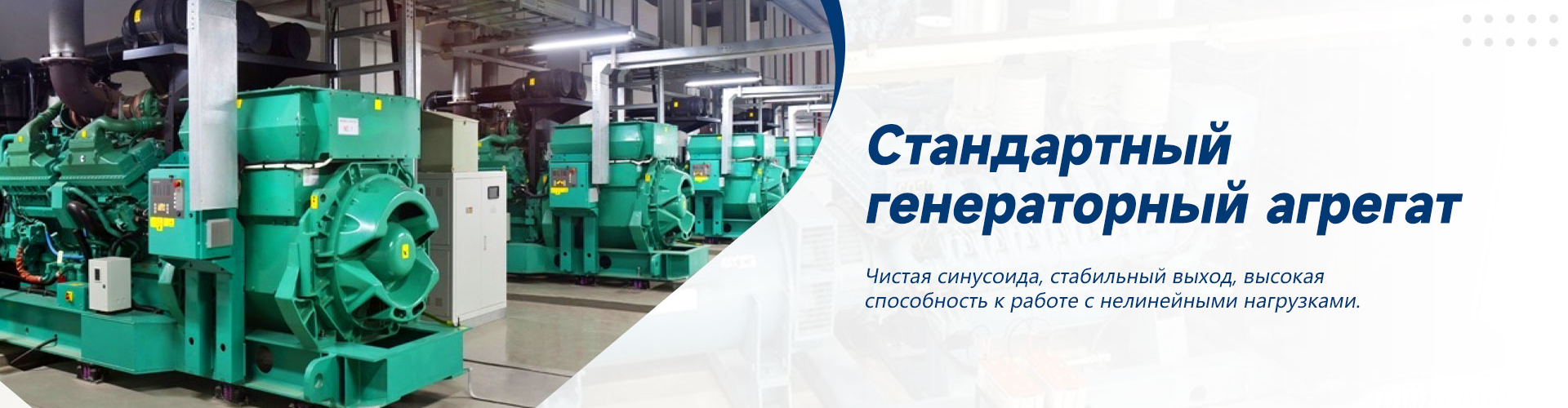
Is China the main buyer of diesel generators?
2026-01-10
You see this headline and you immediately want to say: well, of course, China is buying everything. But if you dig a little deeper, as happens in our business, the picture turns out to be much more interesting and not so clear-cut. Having worked for many years with the supply of energy equipment, includingdiesel generators, I often come across this simplistic view. Yes, the volumes are huge, but the “main buyer”? - it's not just about quantity. This is about the specifics of demand, about the reasons, about where and why these cars end up going. I'll try to explain what it looks like from the inside, without the gloss.
Not just “they bought a lot”, but “why do they need so much?”
When you start to analyze the Chinese market, the first thing that catches your eye is not a homogeneous mass, but a layered cake of needs. Yes, there are government infrastructure projects where entire shipments are purchasedgenerator setsfor backup at power plants, hospitals, data centers. But this is, so to speak, “official”? demand. It's big, but quite predictable and competitive.
The private and industrial sectors are much more interesting. For example, factories in provinces where there are interruptions in the network, or it simply does not keep up with the growth of production. They don’t wait for ideal conditions, but take what is guaranteed to provide current here and now. Often these are not the most expensive models, but they are durable and repairable. Or construction sites in remote areas - they need mobile power plants that can operate in dust and temperature changes. This is a different segment.
And here lies the first nuance: China is not so much the “main buyer?” in the sense of a passive consumer, how much is the main testing ground and driver of certain requirements. Local conditions dictate the need for adaptation: to the quality of fuel, to the climate, to the intensity of operation. Manufacturers who want to sell here are forced to adapt to this. For example, when we started working with engineering for specific tasks, for a long time we could not understand why some standard European solutions “didn’t take root”. It turned out that it was a matter of little things: the availability of spare parts on site, the preferences of local mechanics for certain types of control systems. This knowledge is not written in brochures.
The story of one contract: between ?necessary? and ?how to?
I’ll tell you about an incident that clarified a lot. Several years ago, we participated in a tender to supply diesel generators to a network of small mining enterprises in Xinjiang. The request was, at first glance, standard: power, autonomy, price. We offered a good, proven model from one well-known brand. But they lost.
Later, through personal channels, I found out the reason. Our unit was too “smart” and unrepairable on site. The electronic control system was reliable, but if it failed, it required replacing the entire unit, which had to wait for weeks. A competitor, a Chinese manufacturer, offered a model with a duplicated, simpler control system, where most of the breakdowns could be repaired “on the knee?” by a local electrician. And this outweighed. For the clientuninterrupted power supplydid not mean maximum efficiency, but maximum maintainability here and now. This was a lesson: the technical characteristics in the table are one thing, but the actual operational viability in specific conditions is quite another.
After that, we began to pay much more attention not just to the sale of hardware, but to consultations on adaptation. Sometimes this means offering not the most technologically advanced, but the most durable option. It is this approach that is now valued. By the way, part of this work - analysis, selection, customization - is exactly close to what they do inYuke (Shandong) Electrical Technology Co.,Ltd. I looked at their resourcevoyoko.ru— it is clear that they do not just trade, but work with engineering and technical solutions for tasks, which is critically important in the Chinese market.
Waves of demand: what drives the market besides the economy
Many people think that demand in China depends linearly on GDP growth rates. Partly yes, but there are other, less obvious drivers. One of the most powerful in recent years is environmental policy. The introduction of stricter emissions standards for internal combustion engines has created a surge in demand for fleet upgrades. Old generators that were still working, but did not meet the new standards (for example, Stage II, Stage III), began to be replaced en masse.
This has given rise to an interesting trend: demand fordiesel power plantswith already pre-installed exhaust cleaning systems or for modernization kits. Not all manufacturers were ready for this. Those who responded quickly captured a good chunk of the market. Here, again, China’s role is visible not just as a buyer, but as a regulator, forming new requirements for the whole world. What they implement today may become the de facto standard in other developing regions tomorrow.
Another factor is energy security at the local level. After several major power failures in different provinces, many commercial and even residential complexes began to include backup power not as an option, but as a mandatory part of the project. This is no longer about industry, this is about mass, retail demand. And here not only price is important, but also compactness, noise level, and ease of integration into the finished building.
Suppliers and realities: who actually feeds this demand
Here the picture also changes. Previously, large international brands dominated: Cummins, Perkins, MTU. Now their share is still huge in the premium segment and in critical facilities. But the middle and lower price segments are confidently captured by Chinese manufacturers. And it's not just about the price.
They have learned to make fairly reliable devices for most tasks. And most importantly, they are flexible. They can quickly make modifications for a specific customer and organize service anywhere in the country. For many local contractors and business owners, this is a key selling point. Cooperation with companies such asYuke Electric, which, judging by the description, combines R&D, technical consulting and supplies, is just an example of such an integrated model. They can not just sell a generator, but offer a turnkey solution, which is often what is required.
Our role, as companies with international experience, often comes down to working with complex, hybrid projects where integration of equipment from different brands is required, or to the supply of specific high-power installations where mass local production does not yet exist. But this is a niche. The main flow goes through local players who understand the context better than any foreign expert.
So is he in charge? Instead of output
Back to the title. Is China the world's top buyer of diesel generators by volume? Most likely, yes, statistics will probably confirm this. But if we move away from dry numbers, then something else is more important. China is the main driver of a certain type of demand. This is a market that dictates the need for reliability, understood as maintainability, adaptability of equipment, and compliance with rapidly changing standards.
Working here means constantly being confronted with this practicality. Sometimes it's annoying when you have to abandon an elegant engineering solution in favor of a cruder, but working one. But it is precisely this that makes this market so vibrant and demanding. Buying a generator here is not an act of purchasing a product, but an investment in insurance against uncertainty. And in this sense, China, with its scale and pace of development, really remains a place where this uncertainty, and therefore the need forbackup power, is one of the highest in the world.
Therefore, to answer the question: yes, the main one. But not because he simply buys a lot, but because with his demand he teaches this entire market what diesel generators should look like for the real world, and not for the ideal conditions of a catalog. And this lesson is worth a lot.

-


-
-


WeChat

-
WeChat