

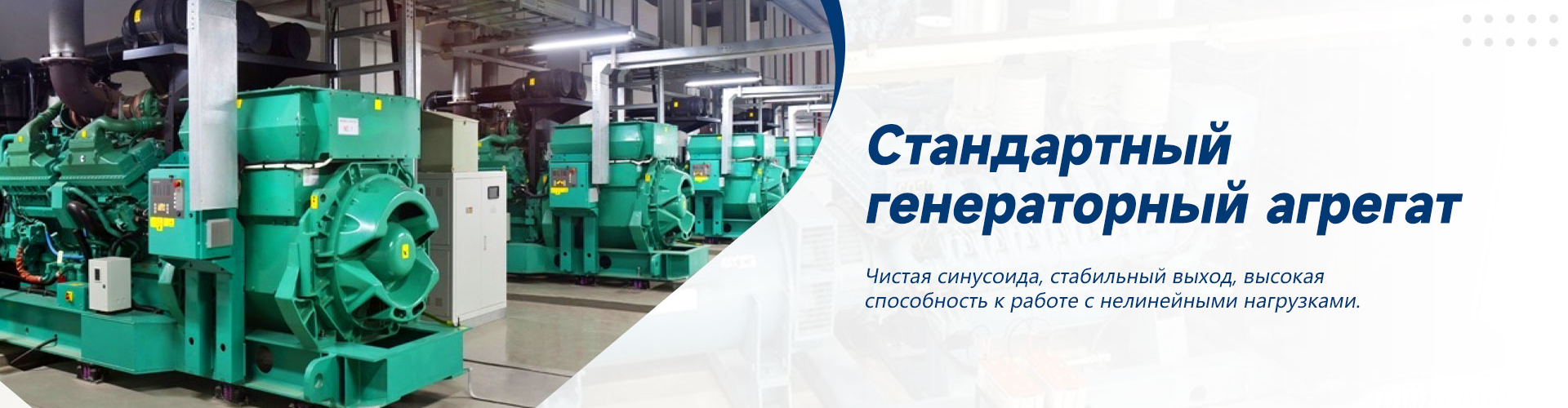
Is China the main buyer of spare parts for generators?
2026-01-17
A question that is often heard at industry meetings and on the sidelines of exhibitions. Many people immediately imagine gigantic volumes and cheap products. But reality, as usual, is more complex and interesting. When it comes to the generator spare parts market, China is not just a buyer. This is a huge, multi-layered and rapidly evolving hub of demand, production and, importantly, re-export. I’ll try to sort it out based on what I’ve seen myself over the past seven or eight years.
What China Really Buys: Not Just Cheap Things
The first and biggest misconception is that China only purchases low-cost components to assemble its units. Yes, there is a mass segment, and it is huge. But if you dig deeper, you see active demand forhigh-tech components: control systems (controllers, AVR), fuel equipment for diesel engines, complex cooling elements. Why? Because local manufacturers who go international (to Africa, the Middle East, Southeast Asia) are forced to increase reliability. Their controllers sometimes act up, especially in difficult climatic conditions, so they are looking for something more stable, often European or Japanese.
A striking example is the story of voltage regulators. About five years ago, one of our clients from Shandong was looking for a batch of AVRs for 500 kVA generators. Their own developments did not provide the necessary stability during load surges, which are common on construction sites. In the end, we settled on Italian modules, although their price was three times higher. But the project required it - the end customer was from the UAE and insisted on a certain level of quality. This was a turning point in my understanding: the Chinese market is radically segmented. At the bottom is a price war, at the top are strict specification requirements.
Another nuance is purchasing for repairs. China operates a colossal number of imported generator sets (Cummins, Perkins, MTU, old Japanese brands). To service them, you need original or high-quality compatible spare parts. And here the demand is very precise: you need a specific part number, often outdated, which is no longer produced in the West. This has given rise to a whole layer of companies that specialize in reverse engineering and the production of such analogues for old models. The quality, to be honest, varies, but the demand is steady.
The role of re-export and gray schemes
This is perhaps the most delicate part. China has long been not only a consumer, but also a powerful re-export hub. Spare parts purchased in Europe, the USA or Japan often end up in China, and from there to third countries where there are difficulties with direct logistics or currency transactions. I saw in practice how a batch of German fuel pumps, shipped in Hamburg, a month later turned up in a warehouse in Guangzhou, and from there went to Myanmar or Pakistan.
This is connected not only with logistics. Sometimes it's about documentation and certification. Localize a batch, add Chinese labels or instructions - and the product changes the chain of movement. This creates a distorted picture of the statistics. Customs data shows imports to China, but the actual end consumer is in a completely different country. Therefore, calling China the main buyer requires a caveat: it often acts as a giant distribution center.
There were also funny cases. Once we supplied a batch of piston rings. According to documents - a Chinese manufacturer of generators. Six months later, it turned out that these rings, being packed in neutral containers, ended up... in Russia, at one of the factories for repairing marine diesel engines. The chain turned out to be longer than we expected. This taught me to always look deeper at the counterparty and try to understand his real role in the chain.
Local production vs. import: where is the border?
Here the dynamics change before our eyes. Just 10 years ago, China purchased almost everything complex. Now the situation is different. Let's take, for example, a companyYuke (Shandong) Electrical Technology Co.,Ltd(Yuke Electric). If you go to their websitevoyoko.ru, it is clear that this is not just a merchant. This is a company with a history dating back to 2003, which positions itself as an innovative technology company combining R&D, technical consulting and supplies. Their activity is a good indicator.
Such companies no longer just buy spare parts, they often act as integrators. They can buy the core of the technology (say, a controller circuit), modify it to suit local standards and climatic conditions (for example, increased dust), set up production and offer their product to the market. And then they can become buyers of individual components for their solution - for example, high-quality chips or connectors, which are still not made so well in China.
Thus, the boundary is blurred. China is not buying finished parts so much as it is buying technology, semi-finished products and critical parts to plug its weaknesses in the production chain. The purchase becomes more targeted and meaningful. On the other hand, for simple components such as cases, radiators, standard fasteners, there is complete self-sufficiency and even export.
Practical difficulties in working with Chinese buyers
If you sell spare parts and enter this market, prepare for specifics. Firstly, requests often come with a requirement for samples for testing. The volumes in the request sound impressive, but after sending free samples, the dialogue may break off. This is not always a scam, it’s just that the competition is fierce, and engineers at the factory test a dozen options, choosing one.
Secondly, documentation is critical. Technical data sheets, certificates (especially CE, but now increasingly also Chinese CCC), detailed drawings with tolerances - without this, don’t even start. At the same time, be prepared that your drawings will be carefully studied for the possibility of localizing production.
Thirdly, logistics and payments. Waiting for payment under a letter of credit may be delayed due to checks within the Chinese banking system. And regarding logistics: we shipped a batch of air filters once. According to the documents, everything was correct, but the Chinese agent demanded that the invoice indicate not spare parts for generators, but components for ventilation systems. It turned out that this allowed them to go through a different, less crowded customs procedure. You have to adapt flexibly, but within reason.
Looking to the future: where is the market heading?
The trend I see is a shift in demand towards smart and hybrid solutions. China is actively investing in renewable energy. This means that the need is growing not for simple spare parts for diesel generators, but for components for microgrid control systems: inverters, converters, synchronization systems. The demand for traditional spare parts will remain huge due to the equipment fleet, but the growth point is in electronics and digital interfaces.
In addition, due to pressure from environmental regulations, there will be an increased demand for spare parts to upgrade older generators to meet new emission standards (for example, urea injection kits). Here China, with its gigantic fleet of equipment, can become a key market for such upgrade solutions.
And one last thing. The dual circulation policy, which encourages domestic production, should not be discounted. This means that many niche spare parts that were purchased yesterday are now being tried to be made within the country. The quality will increase. So, to answer the question from the title: yes, China has been and remains the main buyer in terms of volume, but its role is transforming from a passive consumer to an active selector, integrator and, in many segments, a future competitor for the parts suppliers themselves. The market is becoming more complex, and working with it is becoming more interesting, but also more demanding.
-


-
-


WeChat

-
WeChat