

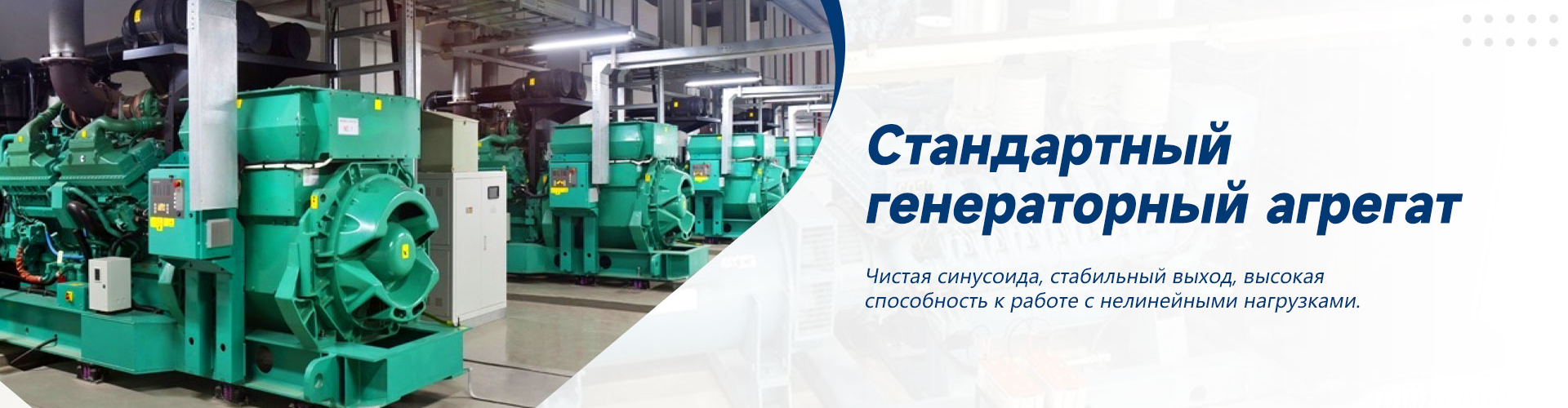
Cheap DGU: AD and choice of purchasing country?
2026-02-07
When you hear “cheap diesel generator”, the first thought is China. But here’s the catch: cheap is not always a synonym for “profitable?”, especially when it comes todiesel generator setsfor CIS countries. Many buyers, especially those who are just starting to purchase equipment, are chasing low prices in the price list, completely losing sight of AD - adaptation. And without this, even the most reliable car can turn into a pile of metal after the first winter or when connected to local networks.
What is hidden behind the word “cheap”?
Price. She is always in sight. When people contact us with the request “we need an inexpensive diesel generator set for a facility in Kazakhstan?”, the first thing I ask is: what do you mean by “inexpensive”? It often turns out that the customer is comparing factory-ready prices from different suppliers. But these figures rarely include the cost of AD - adaptation to specific operating conditions. For example, a standard Chinese diesel generator set will not be suitable for operation at -45°C. You need a pre-heater, an insulated all-round, special oil and a fuel system. This is +15-30% to the cost. Without this ?cheap? the generator simply won’t start on the first frosty night, and losses from equipment downtime will cover all “savings”.
I had a case with a supply for a small mine. The customer found ?very profitable? offer. We tried to explain the need for a reinforced radiator for work at high altitudes and dust protection. Ignored. Six months later I received a photo of an engine that had burned out due to overheating. The savings resulted in many months of downtime and the purchase of a new installation, already with modifications. Here it is, the price of the word “cheap?”.
Therefore, when you see sites likehttps://www.voyoko.ru- company websiteYuke (Shandong) Electrical Technology Co.,Ltd, it is important to look beyond the catalogue. It is important whether they have engineers who ask questions not only about the required kW, but also about average temperatures, altitude, quality of local diesel fuel, voltage standards. TeamYuke Electric, which grew out of DEVER Electric, founded back in 2003, positions itself not just as a seller, but as a technological enterprise with a full cycle from development to construction. This is exactly the structure that, in theory, should understand the importance of AD. But in practice, everything depends on the specific project manager.
Adaptation (AD) is not an option, but a necessity
HELL is the very bridge between “cheap”? goods from the factory and a reliable working asset at your site. Let's look point by point. Climate: for Russia, Kazakhstan, Belarus - frost resistance. For Uzbekistan or Turkmenistan - tropical design, protection from dust and overheating. Electrical: voltage and frequency ratings, type of grounding system (TT, TN-S?). Often in the CIS there are old networks with “jumping” voltage, you need a generator with an appropriate stabilization margin or an external AVR.
Fuel system. This is a separate pain. The quality of diesel fuel in remote regions often leaves much to be desired. Standard fuel filters on basic models clog within a week. A mandatory item in the AD is the installation of coarse separator-settlers, and sometimes fuel heating for the winter period. If this is not done, the warranty case for the engine fuel equipment will most likely not be recognized. ?Did you use substandard fuel? - standard go-ahead.
And lastly, documentation and service. AD includes translation of passports, operating manuals and diagrams into Russian. And the most important thing is the availability of service centers or trained engineers in the purchasing country. It is useless to buy a cheap diesel generator set if for its scheduled maintenance or repair you need to wait two weeks for a specialist from abroad. Companies that work conscientiously, like the sameYuke Electric, propose either the creation of regional service points or the training of local personnel. This is part of their stated model of “technical consulting and engineering construction”.
Choosing the buying country: why does it decide everything?
Everything is intertwined here. The purchasing country determines: 1) Operating conditions (climate, fuel, networks). 2) Customs and certification requirements (technical regulations of the Customs Union, for example). 3) Logistics and final cost. 4) After-sales service capabilities.
A common mistake is to buy an EU-certified unit to work in Russia. There may be discrepancies regarding emission standards (Euro-5 versus Russian standards) or electrical safety. As a result, upon import, problems will arise with customs or Rostechnadzor. A competent supplier initially specifies the destination country and offers a configuration that complies with its regulations. It’s not just “we’ll supply”, it’s “we’ll prepare the equipment for your jurisdiction”.
Logistics are also not easy. It would seem that China is closer to the Far East. But if your facility is in Western Kazakhstan, then delivery through China may be longer and more expensive than, say, through an assembly plant in Belarus, which uses the same Chinese engines, but already modified and brought in batches. You need to consider the Total Cost of Ownership, not the FOB Qingdao price. Sometimes ?cheap? A diesel generator set from China, after paying for all customs clearance, transportation and installation, turns out to be more expensive than the offer from a local integrator.
Practical case: when is it ?cheap? it turned out to be expensive
I’ll tell you about one project that we didn’t receive, but whose fate we watched. A customer from Siberia was looking for a 500 kW diesel generator set to back up a boiler room. Our estimate for the full AD package (arctic starter, insulation, heaters, reinforced frame) was, roughly, 100. He found a supplier who offered a “similar” one. installation for 75. The difference of 25% convinced him.
What was left out of that sentence? The Arctic version was replaced by “moderate” (up to -15°C). Instead of a liquid pre-heater, they installed a cheap thermosiphon one, which did not provide uniform heating. The noise-proof casing was of the simplest design. In the first winter, at -38°C, the generator could not be started in automatic mode when the network was turned off. The boiler room began to cool down. I had to urgently call an emergency team and manually “force” it. launch. As a result, the customer spent about 20 more on modifications already on site: installation of the correct heater, additional thermal insulation, modernization of the control system. Plus reputational risks and fines. The total amount exceeded our initial 100. That's all the savings.
Moral: the dialogue with the supplier should be detailed. It is necessary to require a complete specification with a breakdown of what is included in each line. If the specification says “climate rating UHL1”, but you need operation at -40°C, this is a discrepancy. You need to ask direct questions: “Which model of heater?” What is the degree of automation (1, 2, 3 according to GOST)? Does your proposal take into account local connection standards??.
What to look for when choosing a supplier today
So, to summarize. Chasing the lowest price on the price list is a road to nowhere. You need to look for a partner who understands the essence of AD. The first sign is that it asks a lot of clarifying questions about the object, rather than just dumping the catalog. The second one can provide not just a commercial proposal, but a technical and commercial one, detailing all the modifications to suit your conditions. The third one has references in your region or similar in climate.
Business card sites like the one mentionedvoyoko.ru, is just an entry point. According to the description,Yuke (Shandong) Electrical Technology Co.,Ltdcovers the full cycle: R&D, consulting, supply, construction. This is good. But you need to check it on real projects. Do they have any completed projects, say, in Yakutia or the Urals? Can they arrange installation supervision and training for your staff? Are they ready to be responsible for the performance of the entire system, and not just ship a container with equipment?
Ultimately, ?cheap DGS? - this is not about a low purchase price. This is about the optimal balance between cost of ownership, reliability and compliance with your specific tasks. Correctly carried out adaptation to the buyer’s country is not an overpayment item, but insurance against many times larger losses. The choice is not between ?expensive? and “cheap”, and between “problematic?” and “workers?”. And this choice begins with asking the right questions to the supplier.
-


-
-


WeChat

-
WeChat