

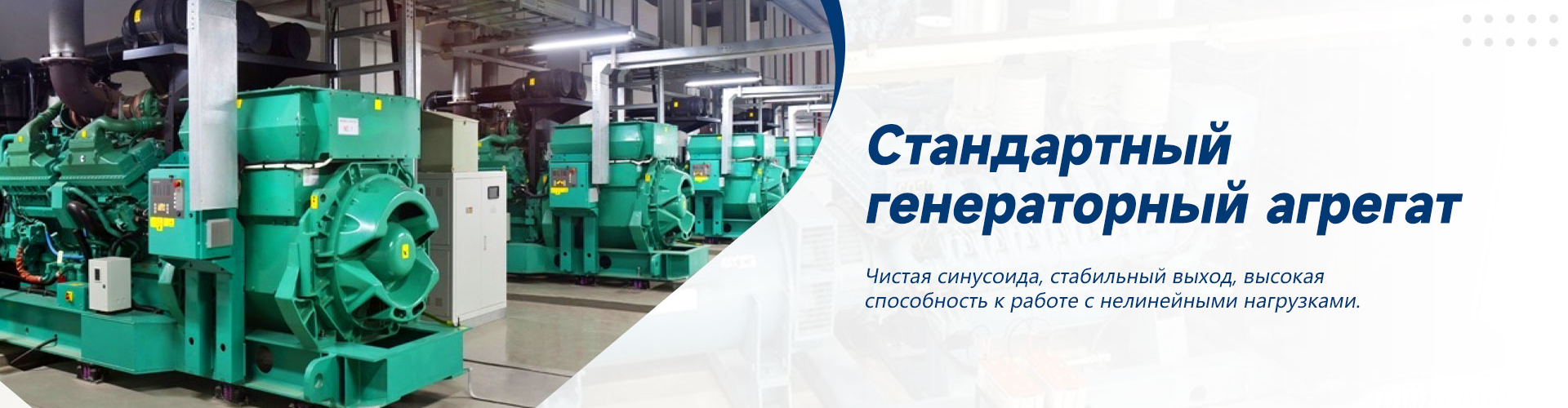
Chinese diesel power plants 1000 kW: who is the main buyer?
2026-01-27
This is a question that constantly comes up in conversations with newcomers to the energy sector or those who are just looking at Chinese equipment. Many people immediately think of large industrial giants or government networks. But the reality, as often happens, is a little more complicated and, to be honest, more interesting. Having been selling and implementing these installations for many years, I see that the buyer’s portrait is formed not so much by the industry, but by a specific, often acute, need for autonomy and reliability. And here 1000 kW is a very significant power, a kind of “golden mean”.
Non-obvious portrait of the main customer
If you put the theory aside and look at actual contracts and requests, the picture becomes clearer. The main buyer for a Chinese 1000 kW diesel power plant is not any one sector, but rather a certain type of facility for which this power is optimal in terms of price/reliability/demand coverage. These are objects that have already outgrown small-scale generation, but for which powerful stations of 2-3 MW and above are excessive capital investments and logistical difficulties.
Most often I encounter mining operations, especially during the exploration or start-up phase of a new site. There are no networks there and are not expected, and the equipment - excavators, crushers, washing units - requires a stable power supply. The key word here isautonomy. Chinese installations in this segment benefit from more flexible configurations and, importantly, speed of delivery. I won’t hide that about ten years ago there were problems with adapting control systems to our harsh conditions, but now many manufacturers, especially those who work closely for export, have solved this problem.
The second large layer is medium-sized processing plants in remote areas. For example, woodworking or primary processing of agricultural products. Energy is needed to operate the line, often in one or two shifts. Building power lines is long and expensive, butDPP 1000 kWYou can install it in a couple of weeks and start working right away. Here, the buyer is especially picky about operating costs, so the issue of fuel consumption and spare parts availability comes to the fore.
Where are the pitfalls and why the choice falls on China
Many people mistakenly believe that the decision to buy a Chinese station is dictated only by price. Price is an entry point, but not the main argument for a serious business. The main argument is a comprehensive turnkey offer. and the manufacturer’s willingness to finalize the project. European brands often offer ?hardware? of the highest quality, but their flexibility in matters of additional equipment, casings, and automation systems is lower. Chinese engineers, as I have seen more than once, are ready to redraw the input-output circuit for a specific customer control panel, which is critically important for many projects.
However, there is a downside. The Chinese diesel power plant market is very heterogeneous. There are dozens of factories, and quality varies dramatically. One of the key problems that we encountered at the beginning was the discrepancy between the declared characteristics and the real ones, especially in terms of overload resistance and the quality of the output voltage under nonlinear loads. It was necessary to strengthen the cooling systems on site or change the voltage regulators. Now, when choosing a supplier, we first of all look not at a beautiful catalog, but at the willingness to provide factory test reports for a specific unit and references in similar climatic conditions, say, in Siberia or the Urals.
In this context, an interesting example of working with a companyYuke (Shandong) Electrical Technology Co.,Ltd(their website isvoyoko.ru). They're not the loudest on the market, but their approach is close to what I'm talking about. The company positions itself as an innovative enterprise that combines R&D, technical consulting and engineering. In practice, this resulted in the fact that for one of our projects for the power supply of a modular spare parts base, they proposed a non-standard solution with separated fuel tanks and a heating system built into the foundation frame. This was their design, not just a compilation from a catalogue. This flexibility is their main trump card.
Use cases: from reserve to primary source
There are also a lot of stereotypes here. It is generally accepted that Chinese diesel power plants are always a “reserve” second echelon. But reality shows otherwise. For the same mining center (yes, there were such requests) or a remote telecommunications station, a 1000 kW station ismain sourceenergy for the entire service life of the facility. In such cases, the requirements for motor resources, automatic starting and monitoring systems are off the charts. And Chinese manufacturers who want to stay in the market understand this. I saw installations that operated for 40-50 thousand hours in basic mode with major overhauls, the schedule of which, by the way, was strictly observed.
Another common scenario is parallel operation with the grid or other generators. This is where difficulties often arise. Not all are "budget" Chinese stations are initially equipped with high-quality synchronization units. You have to either install it separately, which increases cost and complexity, or immediately choose a manufacturer for whom this is an “out of the box” option. This is the point where saving on the initial purchase can result in months of commissioning problems.
And the third scenario - ?nomadic? energy for infrastructure construction. Roads, pipelines, power lines. The station is mounted on a trailer, transported to a new point, and connected. The main enemy here is vibration and dust. There are always complaints about dust protection with standard housings. Our experience shows that you need to immediately order enhanced intake air filtration and modify the fastenings of all internal components, especially piping and electrical panels. Without this it won't work for long.
What influences the purchasing decision: not only technical characteristics
When the client makes the final decision, a table with efficiency, fuel consumption and noise level is only one third of the story. The first is the availability and logistics of spare parts. A Perkins or Cummins engine is one thing, but a Chinese Weichai or Yuchai equivalent is another. The availability of filters, injectors, and gaskets in the region is critically important. From reputable suppliers, such as the one mentionedYuke Electric, this issue is usually worked out: they either keep a warehouse of standard consumables, or have clear agreements with distributors for urgent deliveries.
The second factor is service documentation and training. The most painful experience from early practice is when an installation arrives at the site with a passport and manual only in Chinese, and the electricians on site shrug their shoulders. Nowadays it is rare, but “gray” ones are still found. deliveries where documentation is machine translated. This is a red flag. A real supplier always provides a complete package in Russian, and often organizes the visit of its engineer to launch and train staff.
And the third, often unobvious factor is the possibility of modernization. The world is changing, requirements for remote monitoring and integration with ASKUE systems are emerging. Can the basic station control system be upgraded? Or do I need to replace the entire cabinet to do this? This question is being asked more often, and those manufacturers who build this capability into their control architecture will benefit. This is no longer just selling hardware, but selling a long-term energy solution.
Conclusions and look ahead
So who is the main buyer? This is a pragmatic engineer or business owner who is faced with a specific task: to provide energy to a remote or poorly connected medium-power facility. His choice falls on the Chinese 1000 kW diesel power plant not because it is cheap, but because it is the most balanced according to the criteria of “readiness/functionality/cost of ownership?” solution in the current market. He understands the risks and knows that the key to success is not in the station itself, but in the right choice of partner supplier.
This market has long ceased to be a “pig in a poke” market. It was segmented. There is a lower price segment with high risks, and there is a segment of high-quality engineering solutions, where companies likeYuke (Shandong) Electrical Technology Co.,Ltdoffer truly competitive products that are not inferior in reliability to European analogues in their niches, but are superior in adaptability.
I see the trend of the future here in further “intellectualization?” these installations. The buyer will ask not just about the engine and generator, but about data exchange protocols, compatibility with IoT platforms and the ability to fine-tune operating modes to suit the cost of fuel. And those who can build this into their standard delivery will remain in the game. The rest will remain suppliers of “iron boxes”, competing only on price, which in the 1000 kW segment is a road to nowhere.
-


-
-


WeChat

-
WeChat