

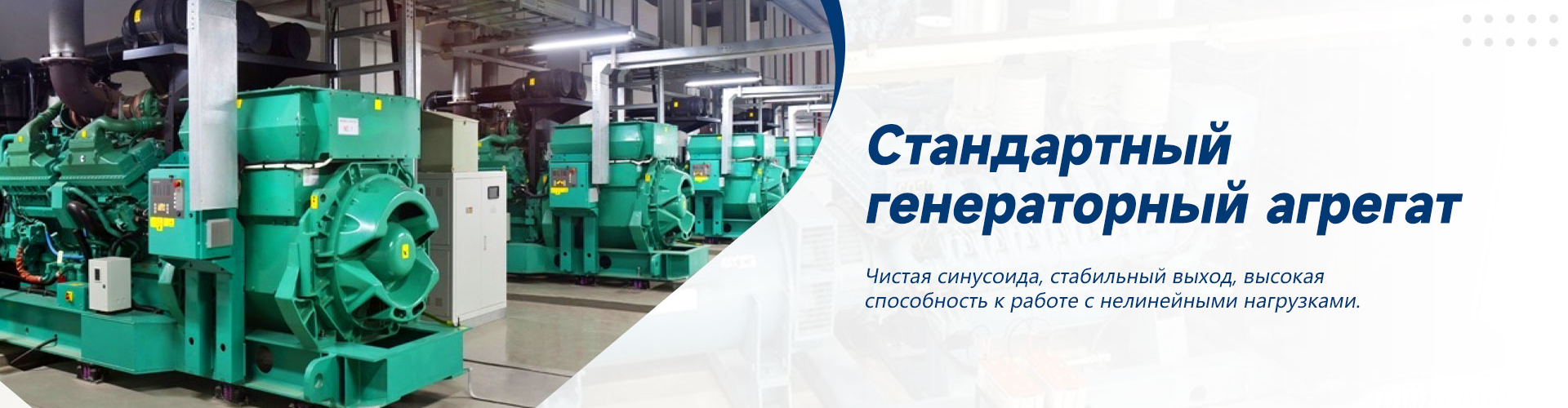
China: who is the main buyer of gas generators?
2026-01-19
When you hear this question, the first thing that comes to mind is, of course, industrial giants, metallurgy, and chemistry. But in reality the picture is more complex and, to be honest, much more interesting. Many people mistakenly believe that the gas generator market in China is a monolith dictated by government plans. In fact, purchasing drivers are highly fragmented and depend on region, fuel type and, most importantly, the specific economic pain of the customer. I’ll try to sort it out based on what I saw myself.
Unobvious demand leaders: not only factories
Yes, traditional heavy industry is a stable consumer. But if we talk about dynamics, then in the last 5-7 years other players have taken over the palm. For example,gas generatorson associated petroleum gas (APG) have become a hit in production areas, especially where there is no developed gas transportation infrastructure. These are not always large oil companies - often they are local contractors who lease fields and need a fast, mobile solution to utilize gas and generate energy for their own needs. Here the demand is very targeted and pragmatic.
Another major segment is the food and processing industry in rural areas. It would seem like a paradox. But I myself have seen projects in the provinces of Henan or Hebei, where large farmer cooperatives or processing plants are installing biogas generators. Raw materials are our own waste. The motivation is not so much in the ?green? energy, how much in the banal economy is connected to networks and in solving the problem of recycling. Government subsidies only fuel this trend, but the root is in cost calculations.
And of course, small and medium-sized businesses in the service sector cannot be discounted. Hotels, resorts, large logistics centers in the suburbs of big cities. For themgas generator- This is, first of all, a source of backup or constant energy supply, especially during seasons of peak load on the network. Reliability here is often more important than absolute efficiency.
Fuel as a determining factor
The type of fuel is a completely different story, which immediately cuts off entire categories of buyers. Discussion with the client always starts with him. Natural gas is for those who have stable access to pipelines, often these are enterprises near large cities or industrial zones. Demand here is growing, but competition with electricity tariffs is fierce.
But the generators onbiogasor landfill gas is a niche but very stable market. Buyers are typically municipal utilities or large private operators of landfills and wastewater treatment plants. For them, installation is a way to comply with environmental regulations and, ideally, generate income from the sale of electricity in a “green” manner. tariff. But the return on investment for projects is capricious and highly dependent on the stability of the gas composition, which often becomes a stumbling block.
Coke oven gas and blast furnace gas are the domain of metallurgical plants. Here the buyer is a plant technologist who thinks in terms of recycling secondary energy resources. Sales in this segment are individual, but the projects are very large and complex. The competition is not so much between generator manufacturers, but between different technologies for using this gas.
Regional features: where is it hot and where is it cold?
Geography dictates demand as much as industry. In wealthy coastal provinces (Jiangsu, Zhejiang, Guangdong), buyers are more often focused on highly efficient and environmentally friendly models, often as part of mini-CHPs. The requirements are strict, price is not the main factor.
In the central and western regions (Sichuan, Shaanxi, Xinjiang) the picture is different. There, there is a higher demand for equipment to operate on local, often low-calorie fuels. What is important is unpretentiousness, maintainability, and the ability to work under conditions of pressure changes and gas composition. Here the winners are not the most technologically advanced, but the most “tenacious” ones. solutions.
Northeast China is a separate matter. Heavy industry is historically strong there, and many enterprises are modernizing old energy centers. The demand is often not for new generators, but for the modernization and reconstruction of existing ones, which requires deep engineering, and not just the sale of “hardware”.
Failures and lessons: why not everything sells
It is a mistake to think that any plant will want a gas generator. We had experience promoting in the segment of textile factories in Shandong province. The logic seemed ironclad: stable heat consumption, the possibility of cogeneration. But we ran into two points. The first is the shortage of space for installation. Old factories are built tightly; squeezing in even a compact module is a headache. The second is operating expenses. Hiring and training personnel for maintenance, albeit minimal, turned out to be a more powerful argument for the owner than potential energy savings.
Another incident is an attempt to enter the market of small coal mines with generators using coal mine methane. Technically - perfect. In practice, it turned out that most of them do not even have a basic system for collecting and preparing this gas. We would have to sell not a generator, but a whole complex, which was beyond our competence and the client’s budget. I had to retreat.
These failures taught us the main thing: before identifying the “main buyer?”, you need to understand his readiness not just to buy a unit, but to integrate it into his own, often far from ideal, technological and personnel reality.
The role of integrators and niche brands
Who brings the buyer and the technology together? Often these are not manufacturers, but engineering companies. They undertake audit, design, selection of turnkey equipment. They are the ones who create demand today. Their choice falls on proven suppliers with a flexible product line and good service support.
For example, take the companyYuke (Shandong) Electrical Technology Co.,Ltd(Yuke Electric). They don't just sell generators. Based on their profile onvoyoko.ru, it is clear that they are just such integrators: R&D, technical consulting, supply, construction. For themgas generatoris not an end product, but a node in a larger energy system that they offer to the client. Such companies are often the “main buyer?” for hardware manufacturers, and then resell the solution to the end user. Their requirements are modularity, compatibility, documentation, and the possibility of customization.
The emergence of players such asYuke Electric, which grew out of an engineering team (mentioned on their website as DEVER Electric, founded in 2003 in Qingdao), is a response to fragmented demand. They cover the pain of the end user with a comprehensive service. Therefore, when talking about the buyer, it is increasingly necessary to look not at the user’s industry, but at sales channels.
So who's in charge?
There is no clear answer. If measured by sales volume in units, this is probably the small-scale energy sector using biogas and APG. In terms of installation capacity, it is definitely heavy industry and oil and gas. In terms of growth dynamics - the commercial sector and agricultural processing enterprises.
But if we discard the metrics and talk about the most stable, conscious demand, then the main buyer today is the one who considers the gas generator not as a separate unit, but as part of its production or environmental strategy. This is someone who considers not only capital costs, but also the full ownership cycle, and who is willing to invest in staff training. Often these are not giants, but medium-sized, technologically flexible enterprises or specialized engineering companies that aggregate demand.
The market has matured to the point where it is no longer equipment that is sold, but a solution to a specific problem: gas utilization, independence from networks, compliance with standards, cost reduction. And the “main buyer?” - this is someone who has such a problem and has the resources (financial and managerial) to solve it. Everything else is specific.
-


-
-


WeChat

-
WeChat