

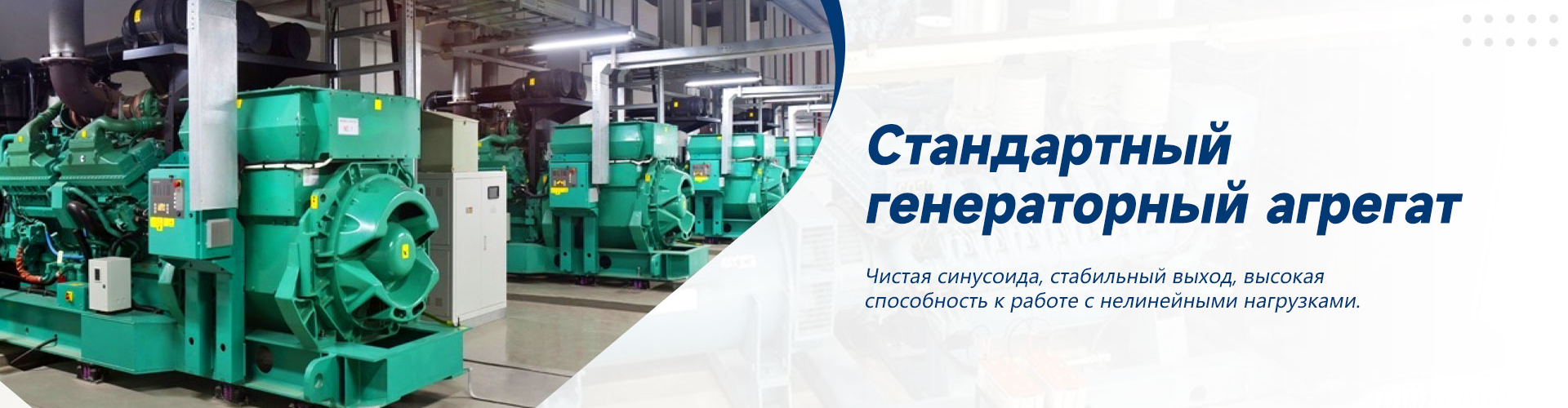
The main buyer of cheap container generators?
2026-02-08
When you hear “cheap container generators”, you immediately imagine either emerging markets or those who are simply chasing a low price. But the reality, as often happens, is more complex and sometimes not obvious. Many people mistakenly believe that the main demand comes from low-income countries, where “as long as it works?” However, based on the practice of deliveries and communication with customers, a different picture emerges - and much more interesting from the point of view of business logic.
Who is really behind the order?
If we discard general phrases, then the core of buyers are not industrial giants or state corporations with an endless budget. Most often, these are small and medium-sized businesses, but not just any business, but those whose activities are strictly tied to specific, often one-time projects. Take construction contractors, for example. They need an energy source at a remote site for a year and a half. Buy expensive, ?eternal? a generator is unprofitable for them - after the completion of the facility, the equipment is idle or it is difficult to sell it without a serious loss in value. Butcheap container generatorsolves this problem: bought it, used it, sold it at the end of the work at a minimal loss, or even transferred it to the next object. Capital is not frozen.
The second large category is companies working in the field of temporary energy supply for events: festivals, concerts, sporting events. For them, reliability is of course important, but the key factor is the total cost of ownership over a short cycle of use. Frequent transportation, possible damage - why risk expensive equipment? In this case, a cheap container is perceived almost as a consumable material. It is important that he fulfills his term of the event, and his further fate is the tenth question. We saw how, after a major open-air in the region, several offers immediately appeared for the sale of used generators - this is exactly from this opera.
And the third, not always obvious segment is startups in the mining industry or geological exploration. They have a site license, a limited budget and high uncertainty. Whether anything commercially valuable will be found there is a big question. They cannot invest millions in an energy center. So they are looking for a quick and cost-effective solution to get the basics done. If the project takes off, they will buy something serious. If not, the equipment will be written off or sold. Risk is minimized. This is where the main motive of the buyer of cheap solutions lies: not poverty, but risk management and flexibility of the operating model.
What are the specifications silent about? Practical pitfalls
Dealing with requests, for example, through our websitevoyoko.ruwhere the products are presentedYuke (Shandong) Electrical Technology Co.,Ltd, you often come across the fact that the client focuses on the price and basic kW, but misses the nuances, which then result in additional costs. One of the most common is compliance with climate control. The container is cheap, but is it designed to work at -35°C or, conversely, in tropical humidity? The specifications may include a streamlined “temperate climate”. But in reality it turns out that the insulation is thin, there is no heating system for the oil and battery, or the ventilation cannot cope with the heat. The client then buys additional heaters, fans, remodels - and the savings disappear.
Another point is the “filling”. Cheapness is often achieved through second- or third-tier components. It’s not that they break right away, but their service life and stability are questionable. For example, automatic transfer of reserve (ATS) may operate with a delay or “stick”. Or the control system is the simplest controller with minimal logic. It will do for an undemanding task, but if you need integration into a more complex network or fine-tuning the priority of loads, problems will begin immediately. We have to explain to clients that they are buying not just kilowatts, but this limited set of functions.
And of course, the service. Cheap equipment often comes with minimal warranty and lack of prompt on-site service support. If the generator is installed somewhere in a remote area of Siberia, you can wait weeks for a specialist or spare parts from China. Project downtime in such a situation eats up? all the initial savings instantly. Therefore, now more thoughtful buyers, even when choosing a budget option, are immediately interested in the availability of service centers or spare parts warehouses in the region, for example, checking the capabilities of such suppliers as Yuke Electric, which is positioned as an innovative enterprise with a full cycle from development to service.
Case study: when savings turned into downtime
I would like to give one illustrative example, without naming names. The client is a company engaged in seasonal sand mining. We needed an energy source for the washing complex for 4 months. We chose the most affordable container generator from a local reseller. The main argument was the price, which differed by 40% from more famous analogues. The first two weeks - work without complaints. Then voltage drops began, which “knocked out” sensitive electronics on pumps. It turned out that the cheap model had a simplified voltage regulator and a weak harmonic filter. The generator provided its 250 kW, but the quality of electricity was low.
I had to urgently purchase and install an external stabilizer and filters. Installation in the field, downtime for a week, additional costs - all this exceeded the original price difference. Moreover, when they tried to sell this generator towards the end of the season, it turned out that its real market value had fallen much more than that of more reliable brands. A buyer was found only at a huge discount. Result: an attempt to save money at the procurement stage led to direct losses and reputational risks (delayed sand shipments). We now often use this case in consultations as an illustration of the fact that cheap does not mean optimal for a business problem.
This leads to an important observation: a smart buyer of cheap generators always budgets for a certain “buffer”. for possible modifications or operational risks. Or initially very clearly formalizes the requirements, checking them with the real capabilities of the equipment, and not just with data from the catalog. Sometimes it’s easier and more profitable to take not the cheapest, but more balanced option from a manufacturer with an R&D department, the sameYuke (Shandong) Electrical Technology Co.,Ltd, which claims technological innovation as the basis of competitiveness. Even if the price is 15-20% higher, you get a predictable result.
Market and prospects: where is demand heading?
An interesting trend is emerging in the market now. Demand forcheap container generatorsdoes not fall, but its structure changes. Previously, the main parameter was “price/kW”. Nowadays, questions are increasingly being raised about the possibility of upgrading, about modularity, about fuel efficiency, even in this segment. The buyer has become more literate. He is no longer satisfied with just an “iron box with an engine”. He wants to understand whether it is possible to later add a monitoring system, switch to another fuel, or increase the service life due to some modifications.
This, by the way, opens up opportunities for manufacturers who can offer a basic inexpensive platform with a “buy later” option. For example, the same Yuke Electric, judging by the description of their activities as an enterprise combining R&D and equipment supply, could work in this paradigm. Not just sell a container, but propose a scheme: first a basic option for a tight budget, and then, when expanding the project, the client buys an automation module or a more economical engine. This is no longer just selling hardware, but selling flexibility.
Another vector is ecology. Even in the low price segment they are starting to ask about compliance with environmental standards, at least the most basic ones. Not because everyone suddenly turned green, but because at some sites (close to populated areas, in environmental zones) equipment with black smoke may not be allowed into use. Therefore, even cheap models are now more often equipped with at least the simplest particulate filters or the injection system is optimized. This is no longer a competitive advantage, but is gradually becoming a must-have.
Thus, the main buyer today is not just a cash-strapped seeker of the cheapest. This is a pragmatist who is looking for the optimal solution for his specific, often temporary, problem. He is willing to put up with some restrictions, but wants to clearly understand their boundaries and risks. And his choice is increasingly determined not by absolute price, but by the total cost of ownership within his business cycle and the ability to adapt equipment to changing conditions. And in this sense, the market for cheap container generators is becoming more and more complex and interesting.
Instead of a conclusion: a few short points for reflection
So, to summarize informally. The main buyer is a professional risk manager, not a lover of cheap things. His key question is: ?How much will my energy cost over the course of the project, taking into account all the hidden costs and possible downtime??
Choosing a cheap generator is often justified, but only after an honest audit of your own requirements and operating conditions. Sometimes ?cheapness? turns out to be more expensive.
The future lies in hybrid offerings: a basic low-cost platform + optional modules for specific needs. Manufacturers who understand this will get a loyal customer base from that same “core buyer”.
-


-
-


WeChat

-
WeChat