

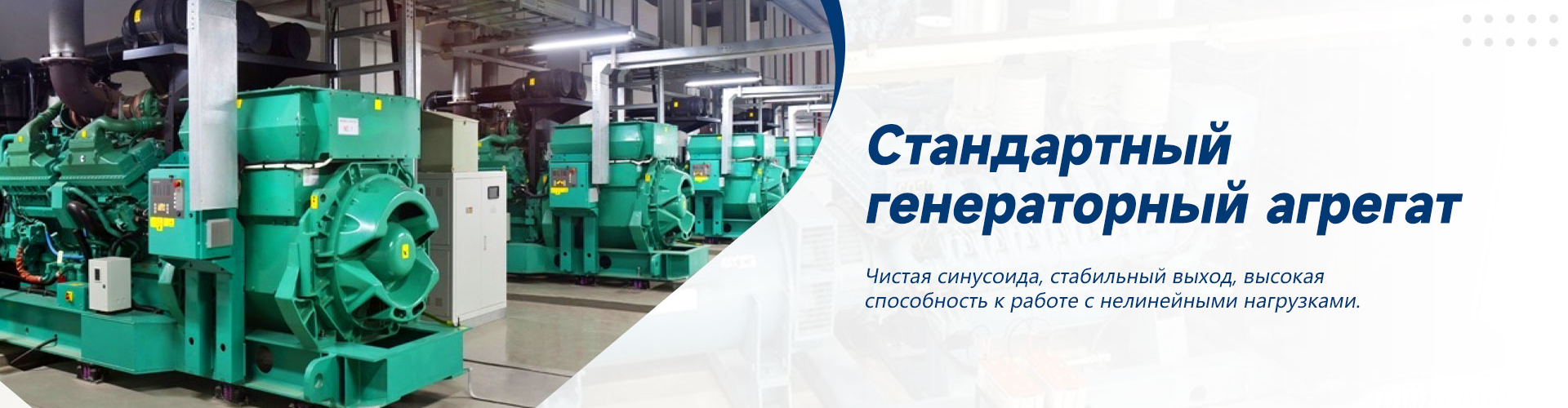
Is China the main buyer of generators?
2026-01-15
This is a question that often comes up in conversations at trade shows or in correspondence with suppliers. I’ll say right away that the wording is too simplified, even a little misleading. China is certainly a huge market, but calling it the top buyer in a global sense blurs the picture. Rather, it is one of the key, but very specific players, with its own internal logic, which is not always clear from the outside. Many people, especially in Europe, imagine just a bottomless cauldron that absorbs everything. In reality, everything is much more interesting and capricious.
Market: not a monolith, but a mosaic of segments
When you say China, you need to immediately clarify - which China? Industrial belt in Shandong or Guangdong? Construction sites in Chengdu? Remote areas of Xinjiang or Tibet? The demand is radically different. For large infrastructure projects, yes, powerful diesel units are needed, often in container versions, with serious requirements for automation. But in parallel, there is a colossal market for small gasoline generators for small businesses, shops, and farms. This segment is incredibly price sensitive; competition here is literally based on dollars.
Here lies the first nuance. China is not only a buyer, but also one of the largest producers. Domestic production covers the lion's share of demand, especially in the middle and low price segment. Therefore, imports are often focused on two poles: either on very specific, high-tech equipment (for example, gas piston cogeneration units with high efficiency), which are not locally produced in the required quality, or, oddly enough, on certain budget models from neighbors, if their cost for some reason turns out to be lower. It turns out to be a kind of balance.
One of the most striking examples is the story ofdiesel generatorsfor mining enterprises in Inner Mongolia. Several years ago we participated in a supply tender. Local manufacturers offered units, but their parameters for resistance to overloads and maintainability in field conditions did not suit the customer. As a result, the contract went to the Koreans, although their price was 15-20% higher. Chinese engineers on the spot clearly argued: downtime due to a breakdown will cost more. This was a lesson - even in a seemingly price market there are niches for more expensive but reliable imports.
What are they really looking for? Key demand drivers
Generalities aside, demand is driven by three things: politics, infrastructure and... natural disasters. State development programs for western regions, for example, directly stimulate the purchase of equipment to supply energy to new villages and enterprises. Here they often buy not just generators, but ready-made solutions - turnkey power plants.
The second point is the quality of electricity in the network. In industrial areas on the East Coast this has gotten much better, but inland surges and outages are not uncommon. For continuous production, say, textile or food factories, this is critical. Therefore, there is a demand for automatic transfer systems (ATS) based ongenerator sets. But it is interesting that they often order not a ready-made unit, but the brains - the control systems, and the power part is assembled locally. This must be understood when offering a product.
And the third, less predictable factor is typhoons and floods. Following the major floods in Henan Province in 2021, there was a surge in demand for mobile, quickly deployable generators for utilities and rescue workers. But this demand is impulse, it is difficult to catch it if there are no established channels with regional distributors.
Traps and pitfalls for suppliers
My own experience and the experience of my colleagues is replete with cases when a contract was broken due to seemingly trifles. One of the main pitfalls is certification. GB (Guobiao, national standards) requirements may differ from international ones, and the obtaining process may take months. Without the necessary certificate for a specific model, it is impossible to sell legally. We somehow lost an entire quarter trying to adapt the exhaust system of a European engine to emission standards for Shandong province.
Another story is logistics and customs clearance. The import of equipment with internal combustion engines is subject to additional checks. One incorrectly filled out form and the container gets stuck in the port of Qingdao or Ningbo, increasing storage costs. You need either a proven broker or, better yet, a local partner who will take care of this.
This is why many foreign companies choose to create a joint venture or work through trusted agents. For example, a companyYuke (Shandong) Electrical Technology Co.,Ltd(YuKe Electric). They are based in Qingdao and grew out of an engineering team founded back in 2003. Look at their websitevoyoko.ru- it is clear that they position themselves not just as sellers, but as a technology enterprise offering R&D, consulting and engineering. This approach - creating a local engineering base - often turns out to be more profitable than trying to sell from a warehouse in Europe. They understand from the inside what is needed for engineering construction and services in the local market, and can quickly adapt the offer.
Case: why the premium strategy didn’t work
I would like to give an example of failure, which clarifies a lot. One well-known European brand, let's call it PremiumPower, decided to enter the Chinese market with a flagship line of diesel generators with noise reduction and digital control. The equipment is excellent, but the price is 2.5 times higher than the market average for the segment. Their target audience was private hospitals and luxury hotels.
The strategy failed within a year. Cause? They didn't take two things into account. Firstly, for many private hospitals, the key when purchasing was not quiet execution (although this is a plus), but the possibility of fast and inexpensive service, and the availability of spare parts in the region. The European service center was only in Shanghai, and waiting 3 weeks for a bearing or control unit was unacceptable. Secondly, in the hotel segment, decisions are often made not by the chief engineer, but by the buyer, whose KPI is budget savings. It’s easier for them to buy two regular generators cheaper than one super-quiet one. There is a premium segment in China, but it requires deep localization of support, and not just beautiful catalogs.
This case illustrates well that technical excellence in itself does not guarantee success. It is necessary to integrate into the local ecosystem of services and decision-making chains.
The future: trends instead of volumes
Now, watching the market, I see a shift in focus. Conversations are increasingly not about buying 100 pieces, but about hybrid systems, about generators working in conjunction with solar panels and storage devices. Interest in gas generators is growing, especially in regions where the Power of Siberia is coming or developing their own shale gas production. Environmental regulations are becoming stricter, and this opens a window of opportunity for technological solutions for exhaust cleaning.
Another trend is remote monitoring and predictive services. Demand for smart generators that automatically report the need for maintenance or potential malfunction is growing faster in China than in many other countries. Here, the digitalization of everyday life is also projected onto industrial equipment.
So, back to the title question. Is China the main buyer? No, this is too rough a definition. It is one of the most complex, dynamic and technologically intensive markets. He does not so much buy generators as look for energy solutions for specific, sometimes very non-trivial problems. And in order to work here, you need to offer not hardware, but a solution supported by an understanding of local specifics, logistics and, critically, service. Otherwise, the story will be similar to the one with PremiumPower - it started beautifully and ended quietly, while local players likeYuke Electricdealt with real turnkey projects from design to construction.
-


-
-


WeChat

-
WeChat