

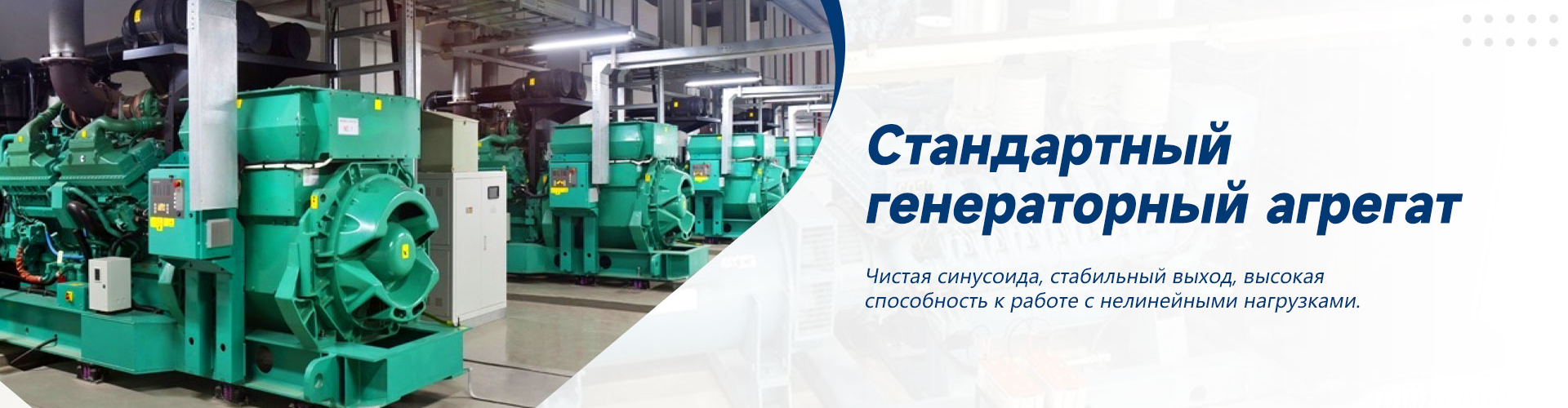
China DGS: who is the main buyer?
2026-01-06
This is a question that constantly comes up on the sidelines of exhibitions and in correspondence with new clients. Many people immediately imagine large-scale government projects or oil rigs somewhere in Siberia. But reality, as usual, is much more interesting and does not fit into one scheme. To be honest, I myself was captive of this stereotype for a long time until I started working closely with supply logistics and saw where containers actually go. The main buyer is not always the one who pays the most, but the one whose needs shape the market itself. And there are several clear segments here, with one of them coming to the fore in recent years to be surprisingly resilient.
Paradigm change: from government orders to the commercial sector
Previously, about ten years ago, the picture was more clear. LargeChinese diesel generator setswere mainly exported under intergovernmental agreements or contracts with state-owned energy companies in developing countries. Funding often came through development banks. Now this channel, of course, remains, but its share in the total flow, according to my observations, has decreased. Why? Because there was a massive, lively and very demanding commercial demand.
We are talking about medium-sized businesses: supermarket chains, small production workshops, telecommunications companies, hoteliers and private hospitals in countries with unstable networks. They are not interested in giant 2 MW plants. They need reliable, relatively inexpensive units of 20-200 kW, which can be quickly ordered, received, installed and which will not be capricious. This is where Chinese manufacturers, especially those who have relied on modularity and adaptation, have taken the shot. I remember how, in one of the first deliveries for a small pharmacy chain in Kazakhstan, we encountered a problem - their technician could not understand the control panel in clear English. I had to urgently make stickers with the translation and send them to them. Now many who want to work in this market immediately plan for Russification or even localization of the interface.
This segment buys not once every five years according to the state plan, but constantly. Their old equipment is breaking down, new outlets are opening, and the workload is growing. Their key criteria are the price/reliability ratio, availability of spare parts and, critically, the speed of response of the supplier. The willingness of Chinese factories to make small batches to specific requirements (say, a noise-insulating casing of certain sizes or non-standard connectors) has given them a huge advantage.
The role of integrators and technical translators
In fact, the main buyer is often not the end user, but the local engineering company or integrator. They are the key link. Selling directly to a manufacturer in China is still a lottery for many, especially those without a strong technical background. The language barrier, difficulties with the guarantee, confusion in certificates - there are too many pitfalls.
That is why intermediary companies appeared, which grew from simple trading firms into full-fledged technical partners. They don’t just import equipment, they select it, provide installation supervision, train staff, and create a spare parts warehouse. They can be called technical translators. They translate local market needs into specifications for the Chinese plant and translate instructions and service procedures from Chinese or English for local engineers.
For example, let's takeYuke (Shandong) Electrical Technology Co.,Ltd(website -voyoko.ru). This is a typical example of such evolution. The company positions itself not just as a seller, but as an innovative enterprise that combines R&D, technical consulting and engineering. For the end buyer from Uzbekistan or Belarus, it is important that he does not have an abstract factory in China, but specific technical support that speaks an understandable language and can quickly resolve the issue. Such companies become quality filters and adapters. They often order semi-finished products from Chinese factories, and then equip them on site with, say, higher-quality batteries or automation systems that are familiar to local electricians.
Geography of demand: where they burn most often
If you look at the shipment map, two main clusters are clearly visible. The first is the CIS countries, and here the leaders are, of course, Kazakhstan and Russia. But not evenly, but in patches. In Russia, these are not only the oil and gas regions of the North, but also, oddly enough, the agricultural regions of the South and Central Russia. There are many small elevators and processing plants that need autonomy. Frequent thunderstorms and worn-out nets are their main motivator. The second cluster is Africa, but the specifics there are different. Often purchases are made through international tenders or NGOs, and the requirements for documentation (such as IEC certificates) are stricter.
There is a third, growing segment - Southeast Asia. Indonesia, Vietnam, Philippines. There, demand is fueling rapid growth of small and medium-sized production. Factories are often built in areas where infrastructure cannot keep up with the pace of construction, anddiesel generator setbecomes a must-have from the first day of work, and not as a reserve. They value compactness and resistance to humid climates - this is immediately evident from the requests that come in: a mandatory requirement for an IP degree of protection for all-weather design.
An interesting nuance in Europe: it is mainly not the diesel generator sets themselves that go there, but power units (engine + generator) under the brands of European assemblers. Or very niche, ultra-quiet and eco-friendly models for camping and events. The mass market for standard Chinese diesel generator sets is closed there due to regulatory barriers and long-established ties with local manufacturers like SDMO or Geko.
Technical trends dictated by the buyer
We used to sell hardware. Nowadays we increasingly sell a feature - uninterruptible power supply. And this changes everything. The buyer, especially a commercial one, wants to do more than just spin a shaft. He wants to see, control and save. Hence the explosive demand for monitoring and control systems via GSM or the Internet. A simple example: the owner of a network of gas stations wants to see from his phone how many hours the generator has worked at each point, when it’s time to change the oil, and turn it on remotely before peak load.
Chinese factories began to respond to this very quickly. Nowadays, even budget models are often equipped with ready-made ports for connecting external monitoring modules. This is a direct consequence of requests from those same integrators. Another trend is hybridization. Not everywhere, of course, but requests for diesel generator sets + solar panels + storage systems for remote sites are coming in more and more often. The buyer already thinks in terms of the total cost of ownership, not just the purchase price.
And, of course, noise. This is a sore subject for urban use. Requests forDGS with noise-absorbing casinghave become almost the standard for objects within the city. And not just a casing, but with guaranteed noise parameters in decibels at a certain distance. Chinese manufacturers have learned to make such casings quite well, although ten years ago this was a weak point - vibration, poor sealing.
Mistakes and pitfalls: what repels the buyer
Not everything is so smooth. The massive entry into the market also led to an invasion of frankly weak products. This hurts everyone's reputation. The most common problems that the end buyer encounters and which integrators like us then have to resolve are: discrepancy between declared and actual parameters (especially in fuel consumption at partial loads), weak components in control systems (boards burn out, cheap sensors fail), problems with the compatibility of additional equipment.
One of our own mistakes at the beginning of our journey was to take the word of factory catalogs on noise levels. We delivered a batch of generators for a hotel complex, and after starting up the client was furious - they made more noise than promised. We had to urgently supply and install additional sound-absorbing panels at a loss. Now we always require test reports from an independent laboratory, or better yet, we test them ourselves at our own site.
Another stumbling block is service and spare parts. The buyer is afraid to be left alone with a broken unit. Successful sellers of Chinese diesel generator sets have understood this and are creating distribution networks with service centers. Those who try to work on the sell-and-forget principle quickly lose the market. The most important buyer today is the one who will buy from you a second time. And he will buy only if the first experience was painless.
So who is he?
Let's return to the original question. The main buyer of Chinese diesel generator sets today is not a monolithic figure, but rather a symbiosis. Thislocal medium business, who has a specific, often urgent, need for energy. And this -technically competent intermediary integrator, which translates this need into the language of metal, wires and controllers, takes on the risks of adaptation and service. The Chinese factory in this chain is increasingly becoming a flexible manufacturer of platforms, which are then customized to suit the market.
Trend? Demand is shifting from cheap and plentiful to reliable, serviceable and with the right options. The buyer has become smarter. He compares not only price tags, but also warranty conditions, the availability of a spare parts warehouse in the region, and reviews of work in similar conditions. And in this new landscape, the winners are those Chinese manufacturers and their partners who have transformed themselves from factories to technology partners. Like the sameYuke Electric, which has grown from a development team into a full-service company. Their website is no longer just a catalog, but rather a demonstration of competencies: R&D, engineering, construction. This is the language spoken by today's top buyer.
Therefore, to give a very short answer: the main buyer is the one for whom the Chinese diesel generator set has ceased to be a pig in a poke and has become a predictable, customizable tool for business. And this demand is primarily generated by entrepreneurs from countries with growing but still vulnerable infrastructure, and those who help them choose and apply this tool wisely.
-


-
-


WeChat

-
WeChat