

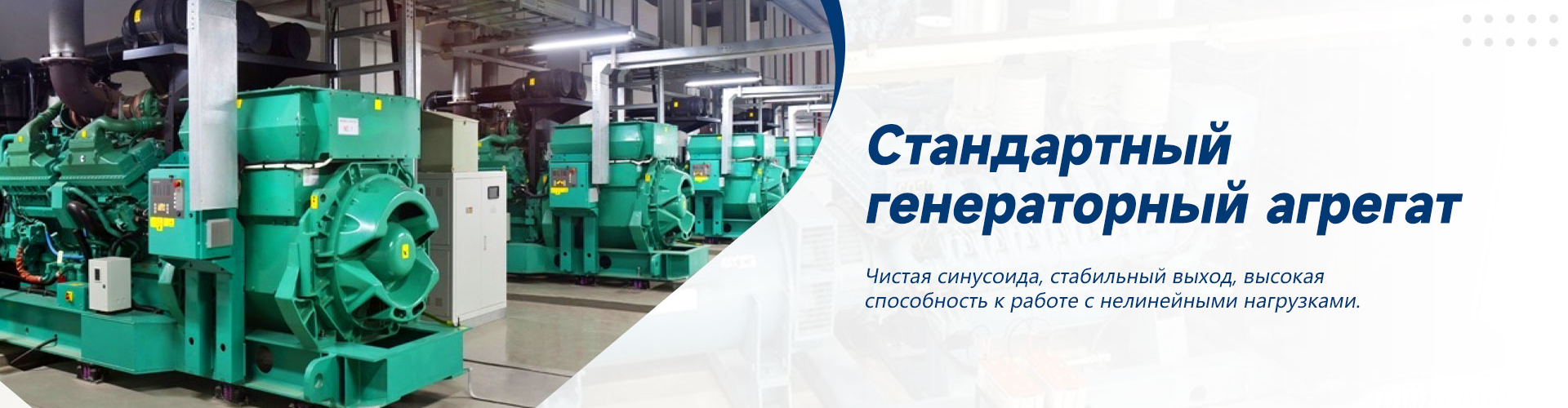
China: leader in diesel generators?
2026-01-05
I often see this question in requests. Let me tell you right away: the answer is ambiguous. If you measure it by production and export volumes, yes, of course. But if we talk about position in the global market as a single concept of “leadership,” then everything is more complicated. Many, especially those who are just starting to purchase equipment, mistakenly believe that “Chinese”? - this is a synonym for “cheap and not very reliable?”. This is an outdated stereotype that prevents you from seeing the real picture. In fact, the industry has long been divided into several distinct segments, each with its own players and rules. I’ll try to sort it out, based on what I’ve seen myself over the years of working with supplies.
Not just “Chinese”: market stratification
Previously, about ten years ago, the picture was simpler. Hundreds of factories in the provinces of Fujian, Jiangsu, and Shandong churned out generators, often assembling them from available components. Quality depended heavily on the conscience of the collector. This is the very low price segment that created the bad reputation. But the situation has changed dramatically.
Now there are three conventional echelons. The first is those same budget solutions for temporary or non-critical tasks. The second is a powerful middle segment, where companies invest in their own R&D, quality control and use good, often licensed, components (Weichai, Shangchai engines, Leroy Somer, Stamford generators). Their products no longer compete on price, but on a set of parameters. And the third is premium, where Chinese factories produce under license or in joint ventures with such giants as Cummins, Volvo, MTU. This is already world-class technology, simply assembled in China.
The key change is a shift in focus from copying to innovation andtechnological adaptation. For example, the same hybrid solutions or remote monitoring systems for diesel generator sets have become the standard for many serious manufacturers. This is no longer just “hardware”, but complex energy solutions.
Where does real competitiveness lie?
Price, of course, is the first thing that comes to mind. But this is just the tip of the iceberg. The main advantage is flexibility and speed. Try ordering a customized power station from a European brand. The timing and cost will not be comparable. Chinese manufacturers, especially from the second tier, have learned to quickly adapt basic models to specific requirements: climate, fuel, level of automation.
Let me give you an example from practice. There was a project for a quarry in Siberia - diesel generator sets were needed, adapted to cold start-up at -50°C and operation in highly dusty conditions. European proposals were prohibitive in price and terms. We turned to a trusted partner in Shandong. They didn’t just install standard units with heaters, but completely revised the design of the air intakes, the insulation system and offered a specific oil. All within a reasonable budget and within three months. This is the onepractical value, for which they pay.
Another point is service logistics. There are now no problems with spare parts for common Chinese engines almost anywhere in the CIS. Entire dealer and service networks have been formed. This is critical for the buyer.
Case: from a development team to a technology brand
In order not to be unfounded, I will take as an example a company whose decisions I encountered -Yuke (Shandong) Electrical Technology Co.,Ltd(Yuke Electric). Their website -voyoko.ru. This is a typical evolutionary story. The company grew out of the DEVER Electric Energy Technology team, founded back in 2003 in Qingdao. This is not just another assembly shop.
Their model is exactly the example of the second-tier strategy I was talking about. They position themselves as an innovative enterprise combining R&D, technical consulting and engineering. That is, they sell not just a generator in a housing, but offer an engineering solution. Their website shows that the emphasis is on creating and promoting their own brand, where the main competitiveness is product and technological innovation.
For me, such companies are indicative. They fill the niche between cheap consumer goods and expensive Western brands. Their target customer is someone who wants predictable reliability, customization and technical support, but without the premium of a big historical name. Working with such suppliers, you see how they delve into technical specifications, ask clarifying questions about operation, and offer options. This is a different level of dialogue.
Pitfalls and how to get around them
Of course, not everything is perfect. Risks remain, and they are mainly management. The main problem is the variation in quality even within one plant from batch to batch. It may be due to a human factor or a sudden change in component supplier. I myself came across when two identical-looking diesel generator sets from the same manufacturer had control panels of different quality in one case and gaskets in the other.
Hence the main rule: never buy “blindly”. A plant audit is required, at least a virtual one. You need to look at production lines, quality control systems, and load testing. A serious manufacturer will always show a video or organize an online broadcast from test benches.
The second point is a clear, meticulous technical specification. You can’t write “diesel generator 100 kW”. You need to describe everything: standards (GOST, ISO8528), permissible noise levels, type of generator (synchronous, asynchronous), brands of key components that are mandatory for you (the same engine or alternator), requirements for color, packaging, documentation. The more detailed the technical specifications, the less room for maneuver to reduce the cost at your expense.
And third, never skimp on pre-sale testing. The contract must include a clause on conducting a FAT (Factory Acceptance Test) with your participation or the participation of your engineer. This is the last frontier where marriage can be weeded out.
The Future: Where is the Industry Heading?
The trends are obvious: digitalization and environmental friendliness. Smart control systems, integration with renewable energy sources (solar panels, wind generators) as part of hybrid systems are no longer exotic, but a growing demand. Chinese manufacturers are very active here because their domestic market also requires such solutions.
Another trend is working on alternative fuels (biodiesel, gas). There are still more experiments here, but developments are underway. Considering strict environmental standards in Europe, this direction will develop.
So is China the leader? In mass production - no doubt. In the technological breakthrough of the middle and upper segment, it is confidently catching up and is already serious competition. But ?leadership? — it is also responsibility for standards, for shaping trends. For now, in this regard, the final word remains with historical Western brands. However, the gap is rapidly closing. Ignore Chinese manufacturers, especially those who rely oninnovation and integrated solutions, today means consciously limiting yourself in choosing effective and economical solutions. The main thing is to approach the choice wisely and with an understanding of the internal cuisine.
-


-
-


WeChat

-
WeChat