

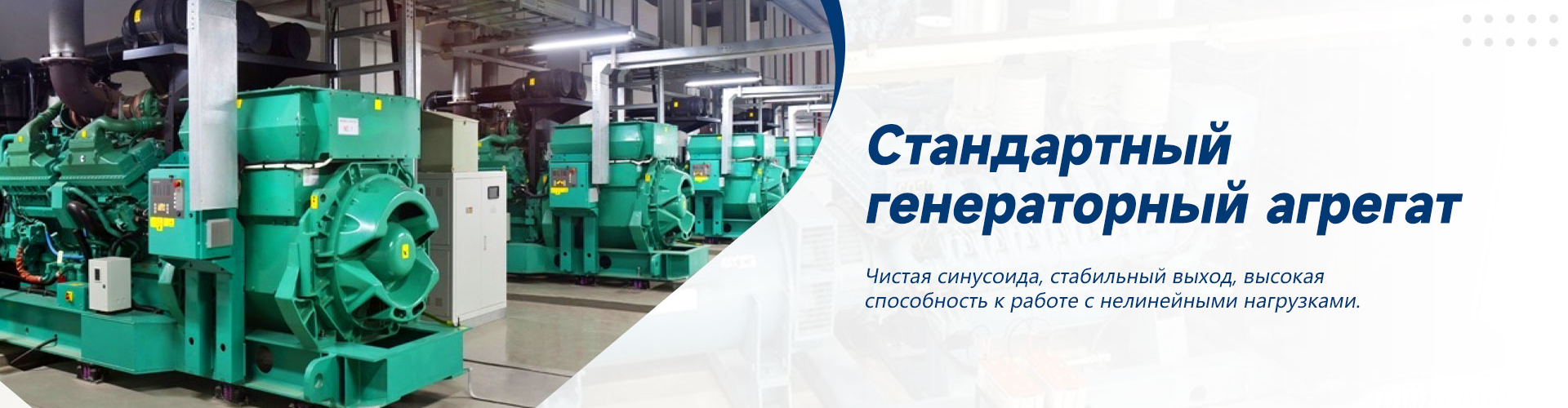
Who is buying Chinese gas power plants?
2026-01-30
I often hear this question, and usually there is a misunderstanding behind it: they think that this is some kind of narrow, niche market for poor countries. In fact, the picture is much more complex and interesting. In short, those who buy it are those who need reliable, relatively inexpensive energy here and now, and who are ready to understand the details. And there is a sea of these details.
Buyer profile: not what it seems
When we just started supplying equipment, I myself thought that the main client was small industries in developing countries that did not have enough power from the general network. This is partly true, but only partly. It turned out that one of the most stable segments is medium-sized businesses in the CIS countries, which have their own boiler houses or technological processes that require heat. It’s profitable for them to betgas power plantfor cogeneration: both your electricity and heat are utilized for heating or technical needs. The economics of the project pays off faster than if you take only electrical power.
The other type are not so much buyers as contractors and engineering companies who put together complete energy solutions. They take Chinese installations as a basis or as a backup option, because for the same money they will receive, conditionally, 1 MW from a European brand, and 1.5 from a Chinese brand, albeit with a number of conditions. Their main task is to meet the customer’s budget, and the customer is often a municipality or a large agricultural holding.
And, of course, there are those who buy for remote sites: quarries, logging sites, temporary settlements. Here the question is not about cogeneration, but about the simple availability of fuel (often associated gas) and ensuring that the installation operates in frost and dust. This is where the real dances with a tambourine begin around specifications and finishing with a file.
Where are the pitfalls? First hand experience
The biggest misconception is that a Chinese power plant is simply cheaper. Yes, capital costs are lower. But cost of ownership is a different story. If you take a bare unit without adaptation, problems will quickly appear: from the incompatibility of control systems with local requirements to the banal instability of paint in an aggressive environment. I have seen projects where the 20% saved on the purchase was then spent on improvements and downtime in six months.
The key point is the power part, that is, the engine-generator itself. Chinese manufacturers here are divided into two categories: those who truly make their own, often based on licensed technologies (here you can remember brands likeYuchaiorWeichai), and those who assemble construction sets from imported components. The difference is in price and, more importantly, in on-site repairability. For a buyer from Kazakhstan or Uzbekistan, the ability to quickly find spare parts is not a matter of money, but of business continuity.
And one more stone is documentation and service. Often the instruction manual comes with a crooked translation, and the diagrams do not correspond to the actual configuration. Without a competent local partner who will undertake installation supervision and commissioning, you can fail the project at the start. That is why companies that do this professionally, and do not just resell containers, are always worth their weight in gold. Like for exampleYuke (Shandong) Electrical Technology Co.,Ltd(Yuke Electric), which has grown from an engineering team since 2003. They are one of those who do not just supply hardware from the sitevoyoko.ru, but is capable of conducting technical consulting and adapting a solution to a specific task - from R&D to construction.
Case study: why it didn’t work
I would like to give an example of failure, it is instructive. There was an order from a small dairy plant in Belarus. A 400 kW power plant was needed to cover peak loads and operate in case of outages. We chose an attractively priced model with an engine from an unknown Chinese manufacturer. Everything seemed to go well, they started up.
But after three months, problems began with the automation system. It was designed for stable gas pressure, and there were seasonal fluctuations in the local network. The factory control unit could not cope, the station constantly crashed. The standard communication protocol also turned out to be non-standard, and integration with the plant dispatch system became a problem. As a result, we had to bring in third-party engineers, order a new control cabinet, and reprogram everything from scratch. Savings turned into additional costs and loss of time.
The conclusion from this? You can't just buy a box. You need to buy a solution that includes an analysis of input parameters (gas quality, climate, automation requirements) and, often, post-sale adaptation. Now, in such cases, we always insist on a test run simulating real conditions.
What are smart shoppers looking for?
An experienced customer, who has already been burned or heard enough stories, comes with a different request. He is no longer attracted by the bare price per kilowatt. He asks about a specific engine brand (they often ask for Perkins, Cummins, or the same Weichai, but with a confirmed license). He is interested in who made the control system - Siemens, DEIF or local assembly. It requires the guaranteed presence of an engineer at the launch and the presence of a consumables warehouse in the region.
He also increasingly asks about the possibility of working on biogas or coal mine methane - this is a trend towards the utilization of associated gases. And here, Chinese manufacturers, by the way, are quite flexible and can offer customized solutions, unlike many European brands with their rigid line.
And most importantly, such a buyer values transparency. He needs not just a distributor, but a technical partner who will honestly say: This model has proven itself well in our quarries, but for round-the-clock work at a bakery, it is better to take this one, with a different maintenance interval. It is this kind of expertise that distinguishes just a seller from a company like Yuke Electric, which positions itself as an innovative full-cycle enterprise - from design to construction.
Results: so who is buying?
I return to the original question. The one who buys is the one who looks at the total cost of ownership, and not at the price tag in the catalogue. These are pragmatists from the real sector: food processors, agricultural enterprises, mining companies, logistics hubs. Those who have access to main or associated gas and who cannot afford long downtime.
They do not buy Chinese, but the best. And if Chinesegas piston power plantin a specific configuration, with the necessary modification and support, gives them this optimality in terms of reliability/price/service, then the choice is obvious. The market has long outgrown the stage of blind saving.
Therefore, when they ask me Who buys?, I now answer: Those who consider not only money, but also risks. And I found someone who will help minimize these risks. Without a competent intermediary who knows both the capabilities of the plant and the realities of the place of operation, the purchase turns into a lottery. But business doesn’t like lotteries.
-


-
-


WeChat

-
WeChat